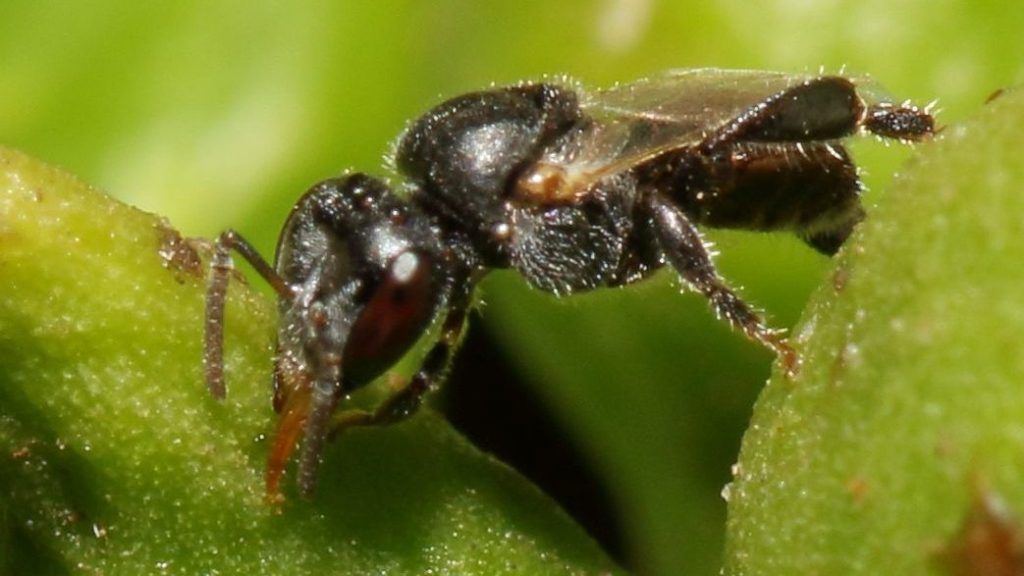
For the first time in the world, in Provincia de Satipo, Perú, a group of insects have been declared subjects of legal rights by a local government. In October 2025, Amazonian stingless bees within the Avireri-Vraem Biosphere Reserve were granted explicit legal rights to exist, to maintain healthy populations in their natural habitats, to not be harmed by human activities, and to be defended and represented in court if their rights are violated [1].
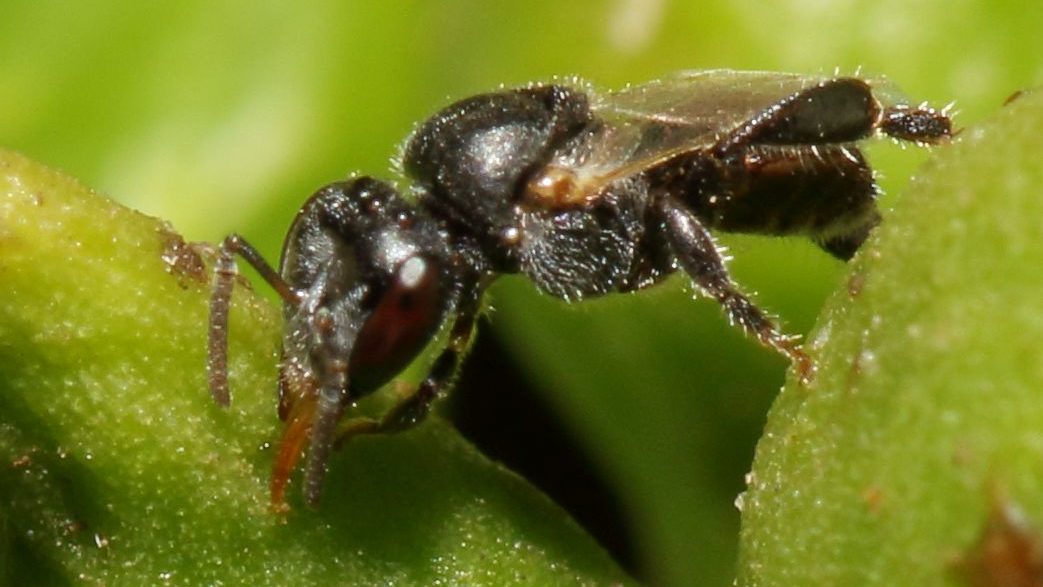
Stingless bees (or meliponines) are not a particular bee species, but a “tribe” consisting of hundreds of species distributed widely in the tropics and subtropics. Like the stinged honey bee, they are eusocial honey-producing insects and form colonies with a single queen bee, large numbers of female workers, and a handful of male drones. They defend their colonies by biting and secreting sticky resin on intruders, which can rapidly overwhelm predators like ants, wasps, and beetles [2]. The ability to quickly turn intruders into tasteful decorative fossils ensures that the lack of a stinger is not at all a problem for these bees.
Meanwhile, stingless bees are mostly docile towards humans, and some (not all) colonies will even allow humans to cut their nests open without so much as a heightened buzzing [3]. They are so gentle that beekeepers in parts of South America apparently refer to them as angelitas [1]. Accordingly, meliponines have been cultured by indigenous groups in parts of South America, Africa, Asia, and Australia for millennia [2]. More than honeybees, stingless bees can boast an impressive résumé for tameness on top of their value as artisans of honey and wax, and as hugely prolific pollinators in the tropics.
If you think about it, though: When has that ever been the core argument that any subject should have rights? Does a creature earn the right to exist and be unharmed, because the creature is directly materially helpful to humans in an inoffensive way? When legal rights are granted to, say, sea turtles to not be harmed or killed by plastic pollution, is the reasoning the same? (That last question is a rhetorical one.) Why is it not?
I’ve poured quite some thought into insect ethics, partly because there was plenty of time to ponder esoterica while I was staring down a stereomicroscope to count mosquito eggs back in my old lab. There was a point when I stopped being satisfied doing molecular tricks to find out what little strings of nucleotides told insect eggs when to hatch. I began to reflect on the fact that I had chosen to work in an insect and bacteria lab rather than a mouse lab, mainly because I thought it was just horrible to be killing mice by the hundreds in pursuit of a piece of gilded paper. To do the same to insects was a lot easier on my nerves. But why? I carried that question on, long after I burnt out of the molecular genetics field.
It was when I changed graduate programs years later that I finally had the chance to work out an answer. I was able to take an environmental philosophy elective – my favorite class I’ve ever taken in my life and a major inspiration to start Ecolalia. With the hearty encouragement of my superb professor, I wrote my final essay on insect ethics, which I enjoyed so much and spent so much time on that I very nearly didn’t make the deadline for my actual master’s thesis. (Once again, I have to wonder if I missed out on my true academic calling, but there’s also something to be said about not mixing your fondest passions and your career.)
In the essay written in 2023, I discussed how insects are viewed in different Western ethical methodologies and how most of them inherently fail to encompass insects as ethical subjects, concluding with an example of what I see as the best methodology to embrace insects as such. I mentioned (and criticized) the rights-based approach to insect ethics. Back then, there was not even a hint of legal protections for any insects in the world, and even now there still isn’t for insects in scientific research or husbandry (as there are for vertebrates), so there’s clearly still room for improvement there.
The world-first granting of legal rights to insects in the Peruvian Amazon has inspired me to revisit this insect ethics essay and share it here on the blog. You can find my essay on bug ethics linked here.
References
[1] Tomassoni, Teresa. “Defending Stingless Bees in the Peruvian Amazon.” Inside Climate News. October 22, 2025. https://insideclimatenews.org/news/22102025/peru-amazon-stingless-bees-rights/
[2] Shanahan, Maggie and Marla Spivak. “Resin Use by Stingless Bees: A Review.” Insects 12, no. 8 (2021): 719. https://doi.org/10.3390/insects12080719
[3] Portal, Ariane Storch and Caio Mauricio Mendes de Cordova. “Propolis from Meliponinae: A Highway from Ancient Wisdom to the Modern Medicines.” In Melittology – New Advances, by Muhammad Asif Aziz, 1 – 21 (IntechOpen, 2024). https://www.intechopen.com/chapters/1155880
[4] Tomassoni, Teresa. “Countries are starting to give wild animals legal rights. Here’s why.” Washington Post. August 26, 2023. https://www.washingtonpost.com/climate-solutions/2023/08/26/leatherback-turtle-nature-rights-panama/


 ecolalia

Leave a comment