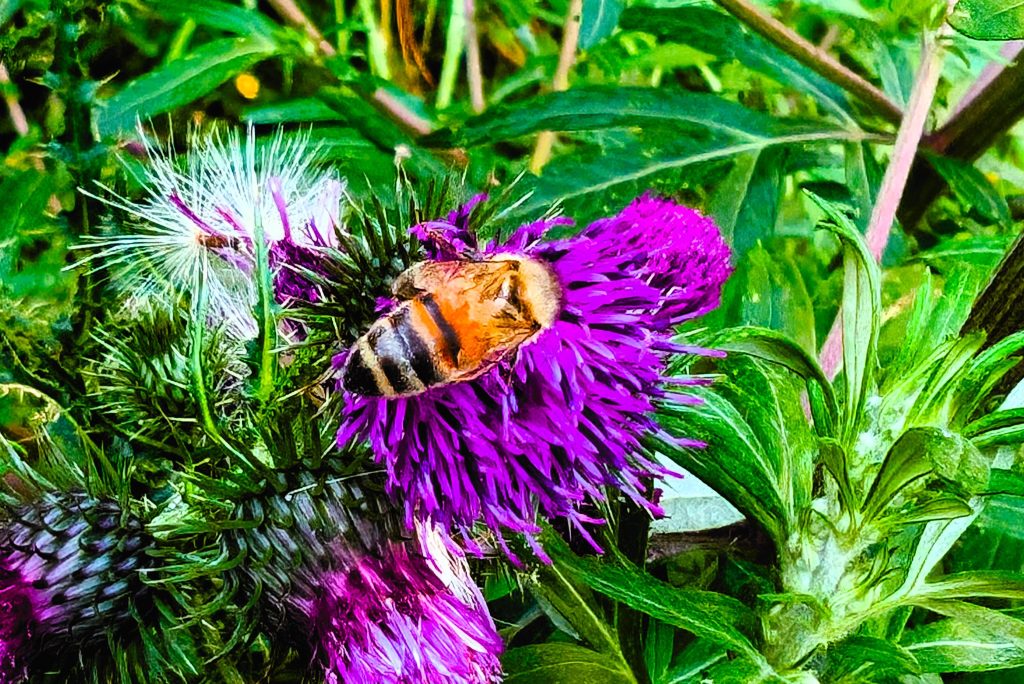
This post is the second of a two-part series “Buggy ethics,” wherein I explore ethics, morality, and the insect-human eco-cultural relationship. This second part features an essay I worked on in July 2023 for an environmental philosophy elective, lightly edited for style. In light of recent advancements in insect legal rights, I hope this essay is able to contribute to the ways humans think about and integrate insects (and other non-human subjects) into a more inclusive moral ecology.
Without further ado, here it is:
A narrative ethical approach to insect ethics
We can no longer afford to think about ethics in separation from insects, and the big and small edges of sentience they evoke.
Stephen Loo and Undine Sellbach1
Not too long ago, I worked in a laboratory studying the social organization of fire ants. Every day, it was something of a heart-pounding thrill to take a colony out of storage and see the thick teeming mass of superorganism, the black quivering static of hundreds of thousands of ants jostling for a drop of honey water.
To me, insects were the perfect subject of biological curiosity: compact creatures that are simple but not too simple, easy to care for, different and seemingly indifferent enough that my squeamish self didn’t feel guilt in raising them in a cage to harvest their offspring. (I had only once let myself see a pregnant lab mouse get euthanized before I decided that kind of subject wasn’t for me.)
I’ve been interested in the ways that humans think about insects for a long time now. There is something I’ve found dissatisfying about the mainstream ethical discourse on insects. It is not as simple as myself being against killing or experimenting on bugs (which is, in a lot of cases, not true); it just seems that insects remain an afterthought in Western environmental philosophies overall. This is despite their being the overwhelmingly dominant animal life form on earth and among the most threatened by anthropogenic environmental change. As Danielle Sands insists, confronting our ethical relationship with insects will be crucial to “help us find a pathway through the maze of our representations and facilitate new approaches to current environmental problems.”2 Insects, by providing unique perspectives on scale, environmental boundaries, and perception under global change, “are revelatory of our Anthropocene condition.”2 Insects thus present a vital study and challenge for modern environmental ethics.
In this essay, I describe the trouble of incorporating insects into mainstream Western ethical methodologies. The first section explores insects in the context of animal rights theory, and the second section attempts to locate insect ethics within empathetic entanglement. In the third and final section, I introduce a synthesis of rational and relational approaches in the form of Val Plumwood’s intentional recognition stance towards the more-than-human world. I argue that insect intentionality provides us with the best route towards the recognition of insects as both narrative agents and ethical subjects.
I.
It may come as little surprise that there are no ethical standards for the treatment of insects in scientific research or husbandry, while such protections exist for vertebrates in most parts of the world.3 It is not a popular stance to advocate for insect rights, even among animal rights thinkers. This is in spite of well-reasoned and internally consistent arguments that existed over three decades ago, such as the one positioned by entomologist Jeffrey Lockwood, who advocated for better rearing conditions for insects as well as the use of anesthetics prior to dissection:
Considerable empirical evidence supports the assertion that insects feel pain and are conscious or aware of their sensations… We ought to refrain from actions which may be reasonably expected to kill or cause nontrivial pain in insects when avoiding these actions has no, or only trivial, costs to our own welfare.4
There have been large strides in the understanding of insect consciousness in the years since, but almost no progress in the elaboration of insect rights in animal rights theory. Peter Singer, while referencing a landmark 2016 study that the insect brain shows the capacity for subjective experience (and therefore consciousness), nevertheless concludes:
We still do not know enough about insect subjective experiences to [launch a campaign for insect rights]; and, in any case, the world is far from being ready to take such a campaign seriously. We need first to complete the extension of serious consideration to the interests of vertebrate animals, about whose capacity for suffering there is much less doubt.5
Lockwood, who drew heavily upon Singer’s own work to develop his argument for insect rights, would be astonished by Singer’s statement in light of the greater evidence we have today for insect sentience. It is unclear at which point it would become an unacceptable risk for Singer to keep condoning the vicious way that the majority of humans presently treat insects. Donaldson and Kymlicka, meanwhile, also admit the possibility of insects possessing sentience, but ultimately skim over this “gray area” to focus on asserting the rights of cows, chickens, rats, and monkeys, which are common (vertebrate) livestock and laboratory animals. To rationalize their de-emphasis of invertebrates such as molluscs and insects, the authors make the interesting proclamation that “the types of animals that are most cruelly abused are precisely those whose consciousness is least in doubt.”6
Donaldson and Kymlicka are insisting that it is primarily non-human vertebrates that human beings harm, but of course this statement is untrue. Over one quadrillion insects are killed each year by agricultural pesticides alone (many being untargeted butterflies, bees, and aquatic insects). Countless flies and cockroaches in human dwellings meet their unceremonious end under the sole of a shoe or with a spurt of bug spray. Insects are massively farmed as well, for silk, dye, and increasingly for food.7 And of course, great numbers of insects are reared, experimented on, and killed in laboratories around the world, from the favored genetic model organism Drosophila to colonies of fire ants. Plenty of these deaths are chemically induced and likely unpleasant, and a huge number of these killings are not necessary for human welfare. That Donaldson and Kymlicka overlooked this is perhaps because, since insect consciousness is in doubt (though this is an increasingly weak position to take), it cannot be established that they are being cruelly abused. This is a type of circular reasoning that seems prevalent in animal rights theory when it comes to insects, and thus it appears that trying to elucidate an insect ethics with a rights-based methodology has run us into a ceiling.
Lockwood made his case well on paper, but there was and still clearly is an issue with preaching moral obligations to insects to groups of people for whom swatting flies, crushing roaches, and trapping ants have been part of everyday life since childhood. Animal rights theory can be the basis of rational arguments for insects as ethical subjects, but the unwillingness to carry the discourse to its logical conclusion points to a deeper issue that this methodology cannot address.
The issue is this: most humans simply have an aversion towards most insects. Most people will not go out of their way to protect an insect, and even those who do would probably understand why others don’t. Giovanni Aloi draws our attention to the expression “wouldn’t harm a fly,” noting that the harming of flies is “the easiest and most commonplace sign of violence one could commit, at once irrelevant and normalized by cultural habits.”8 Aloi takes it as a telling example that the animal rights organization PETA stopped short of denouncing the televised and prominently news-covered killing of a fly by American president Barack Obama.9 Championing the rights of insects seems to be pragmatically indefensible, even for some of the most well-known radical animal rights activists.
II.
Is there a way for us to strip away the reliance on the abstract concept of “sentience” to inform animal ethics? One methodology sought to do just that, emerging as a critical alternative to the rights-based approach and adapting concepts from (eco)feminism and care ethics. This ethical approach is based on the ontology of entanglement, or the embeddedness of humans in relationships with one another as well as with nature. It views ethics in terms of embodied relations among beings rather than individual identities and it stresses the role of empathy and attention to other beings in ethical behavior.10 With such an approach, we seemingly are in a better position to directly address the issue of current human relations towards insects.
Lori Gruen, one of the major proponents of entanglement ethics, has written about the importance of empathy in this relations-based ontology. She outlines an approach of “entangled empathy,” defined as:
A type of caring perception focused on attending to another’s experience of wellbeing. An experiential process involving a blend of emotion and cognition in which we recognize we are in relationships with others and are called upon to be responsive and responsible in these relationships, by attending to another’s needs, and interests, desires, vulnerabilities, hopes and sensitivities.11
Empathy requires a differentiation between the self and the other, as well as “imaginative perspective-taking” that allows one to participate in the experience of the other’s suffering12, thus compelling one to recognize and resist injustice towards others (which can be animals as well as human beings). It is reminiscent of Cora Diamond’s proposal to view animals as “fellow creatures;” not as biological entities that do or do not possess certain abstract qualities, but as companions in existence with whom a relationship, a kind of kinship, is recognized to exist.13 This way of thinking is attractive in that it presents a potential way to redress anthropogenic environmental degradation. After all, the subjugation of animals, plants, places, and ecosystems can be convincingly traced to modes of thinking that create a dualism between beings that matter morally and beings that do not (and therefore a hierarchy where human sovereignty trumps all other concerns).
The place of insects in this relational ethics discussion, however, seems to be as ambiguous as before. Insects’ small size, tendency to swarm in huge numbers, “utterly alien” morphology, and indifference to human presence and structures mark a major difference from other animals14, and inspiring affective responses ranging from awe at delicate, beautiful butterflies (at one extreme) to revulsion for the strange appearance and seeming invulnerability of flies and cockroaches (at the other, more recognizable extreme).15 Overall it is the latter emotion that predominates, and seems to render insects ethically inconsequential, if not as a despised enemy. Sands observes “the striking velocity of disgust… poses a significant challenge to one’s investment in such kinship [with insects].”16 Elias Canetti meaningfully describes one view of the insect under the contemporary Western human gaze – that of extreme insignificance as to be beneath notice: “You are an insect. You mean nothing to me. I can do what I like with you and that won’t mean anything to me either … You can be destroyed with impunity without anyone noticing.”17 Gruen summarizes the difficulty of practicing entangled empathy with the insect world:
My connection to [insects] remains thin. I am not moved to act for their sakes if there are other conflicting values in play. I won’t harm them and will try to move them to safety insofar as I understand where that might be, but I can’t say I am acting from empathy when I do so… It isn’t possible to be in empathetic relation to ecosystems or organisms that exist in ways that I can’t imagine, beyond metaphor or projection, what it is like to be like.18
This normalized, implicitly vicious attitude towards insects coupled with the difficulty of imagining insect perspectives explains the general reluctance in Western philosophy to recognize insect sentience or ethical value. Diamond touches upon the devalued category of animal: the “vermin” (pests which are either insects, or insect-like in numbers and persistence) for which the mercy that would be felt for a fellow creature does not apply.19 And indeed, observing the mass death of insects, vermin and benign alike, with our nonspecific chemical pesticides inspires little remorse. The practice may be increasingly curbed only by recognition of the economic losses from the decline in pollination, natural pest control, and biodiversity that insects support, and not by what it means to harm the insects themselves. It is here that insects once more seem to confound integration into environmental ethics.
III.
I sit under a tree, and feel alone: I think of certain insects around me as magnified by the microscope: creatures like elephants, flying dragons, etc. And I feel I am by no means alone.
Thomas Hardy20
The minute world of insects is transfigured by the power of imagination that cancels dichotomic stances, thus placing men and the invertebrates in a state of intimate and mutual dependence.
Emanuela Ettorre21
After exposing the conundrum that insects continue to pose in Western environmental philosophy, I now proceed to the crux of my argument. The shortcomings of our previous approaches were evidently due to searching for similarities with a human center, whether by abstract criteria such as consciousness (for the rights-based approach) or by relatedness in appearance and behavior which evoke empathy (for the entanglement approach). It is clear that these methods relying on sameness or relatedness will not suffice for the extreme “Other other” represented by insects.22 What way is there for us to move forward with an insect ethic that does not stumble on these anthropocentric hurdles?
Searching for a solution in the face of hyper-rational moral dualisms as well as potentially “unanalyzed and capricious” empathy when viewing earth others, Val Plumwood proposed the philosophical stance of intentional recognition for non-human minds:
Adopting the intentional recognition stance is one of a number of counter-hegemonic practices of openness and recognition able to make us aware of agentic and dialogical potentialities of earth others that are closed off to us in the reductive model that strips intentional qualities from out of nature and hands them back to us as ‘our projections’.23
Plumwood argues that intentional description – involving the recognition of agency in nature and that of the earth other as “originator of projects that demand our respect”24 – is crucial to allow negotiation and mutual adjustment to the more-than-human world. The stance of recognizing intentionality, for Plumwood, allows for natural beings to be conceived as narrative and ethical subjects. She reminds us that intentionality can provide humans with the foundation for respecting non-human minds as well as understanding our own selves:
Some of the minds we encounter are able to tell us basic ecological things long forgotten or grown oddly unfamiliar… They include those of canny animals who gaze back, size you up and tell you who you are – a dangerous predator! – and where you get off. To stay alive and reproduce they have to – and to all but the most reduction-blinded observer patently do – think ahead, try to outsmart you, work out how to escape your reach…25
While Plumwood does not directly explore the intentionality of insects to conceptualize them as ethical subjects, her framework does provide us with better ground to stand on. The intentional recognition stance is evidently readily applicable to insects, though this strategy depends on embracing an “older, more inclusive way” of thinking.26 In our case, this takes the form of the childlike activity of taking real notice of the behavior insects engage in – digging burrows, flitting among pools of water, buzzing around our computer screen in the evenings. Through this simple act, we can become cognizant and respectful of insect agency to influence their worlds, even as it often does not directly relate to us (but sometimes also does in major ways).
I can speak for myself that spending time observing insects in my adult life had inadvertently increased my intentional recognition of them. A fire ant once escaped the confines of its Petri dish and quested up my bare arm, antennae flicking to and fro like a tiny orange flame, wholly indifferent to the tension in the limb fearing its painful sting. Quite clearly, I saw myself as the terrain for its enterprising search for a way back to the colony, a hundred meters down the hall that suddenly exploded in my mind as the length of a planet away. When a few worker ants were dropped on a dish containing the queen, they immediately surrounded their large mother and caressed her with their antennae and forelegs, “keeping her calm,” as my lab mentor fondly told me while we waited for her to lay eggs for our experiment. These creatures had their own clear intentions and agency, in which I or any human was too inconceivably large and long-lived to be anything but the landscape.
Fire ants, of course, are fearsome invasive insects in the wild and mostly not benign curiosities in a controlled environment like in my example. It remains clear that recognizing the unique intentionality of these insects and many others creates a kind of fundamental respect that will allow us to “stay with the trouble” (to borrow a term from Haraway) of what it means to exploit and kill them. It will grant us a greater understanding of when it is necessary and by what means, and what is at stake by resorting to these means.
There is a kind of narrative flourish needed to evoke and understand the intentionality of the more-than-human world. I maintain that this is not a weakness of the approach, but rather an imaginative strength that maximizes our sensitivity to all beings, even those such as insects, which usually fall beyond the direct considerations of animal ethics. I will conclude this paper by providing a brief example of what this might mean in practice, to develop the insect as an intertwined narrative and ethical subject.
The English novelist Thomas Hardy has been noted for the “humane and sensitive” fascination with the natural world in his prose, particularly insects, which he positions as transient yet recurrent companions in the lives of his characters.27 In his novel The Return of the Native, there is a scene where the protagonist Clym works at chopping furze and perceives his company in a vast array of buzzing, fluttering, and creeping insects:
[Clym’s] daily life was of a curious microscopic sort, his whole world being limited to a circuit of a few feet from his person. His familiars were creeping and winged things, and they seemed to enroll him in their band. Bees hummed around his ears with an intimate air, and tugged at the heath and furze-flowers at his side… Tribes of emerald-green grasshoppers leaped over his feet, falling awkwardly on their backs, heads, or hips, like unskilful acrobats, as chance might rule… Huge flies, ignorant of larders and wire-netting, and quite in a savage state, buzzed about him without knowing that he was a man. …None of them feared him.28
Hardy is able to convey a narrative agency in his insects’ indifferent yet recurring engagement with human characters. As Plumwood earlier illustrated the intentionality of canny animals which respond to our presence in ways that remind us that we are predators, insects also display an intentionality which upsets our sense of hierarchy and is a reminder of our own lack of superiority and fleeting existence in the grand scheme of the universe. Emanuela Ettorre writes that Hardy’s insect narrative can help to “destabilize the predominant viewpoint from which reality can be perceived and represented.”29 Ettorre finally concludes on insects as a narrative subject:
If even insects…are neither slaves of their body nor passive victims of senescence, it means that the only way to look at human life and old age that consumes and mars, is through the somehow ‘liberating’ viewpoint of the grotesque.30
By engaging in the description of insects as intentional agents, I hope I have shown that we will be able to foster and maintain the recognition of insect intentionality, and create a much-needed space for insects in ethical consideration.
References
- Loo, Stephen, and Undine Sellbach. In “Insect Affects: The Big and Small of the Entomological Imagination in Childhood.” Angelaki 20, no. 3 (July 3, 2015), 10. https://doi.org/10.1080/0969725X.2015.1065125
- Sands, Danielle. “Insect Ethics and Aesthetics: ‘Their Blood Does Not Stain Our Hands.’” In Animal Writing, by Danielle Sands, 154–79. (Edinburgh University Press, 2019). https://doi.org/10.3366/edinburgh/9781474439039.003.0006.
- Freelance, Christopher B. “To Regulate or Not to Regulate? The Future of Animal Ethics in Experimental Research with Insects.” Science and Engineering Ethics 25, no. 5 (October 2019): 1339–55. https://doi.org/10.1007/s11948-018-0066-9.
- Lockwood, Jeffrey A. “The Moral Standing of Insects and the Ethics of Extinction.” The Florida Entomologist 70, no. 1 (March 1987), 83. https://doi.org/10.2307/3495093.
- Singer, Peter. “Are Insects Conscious?” Project Syndicate. May 12, 2016. https://www.project-syndicate.org/commentary/are-insects-conscious-by-peter-singer-2016-05
- Donaldson, Sue, and Will Kymlicka. Zoopolis: A Political Theory of Animal Rights. Oxford: Oxford University Press, 2011, 31.
- Sebo, Jeff and Jason Schukraft. “Don’t farm bugs.” Aeon. July 27, 2021. https://aeon.co/essays/on-the-torment-of-insect-minds-and-our-moral-duty-not-to-farm-them
- Aloi, Giovanni. Art and Animals. (Bloomsbury Academic, 2012), 116.
- Aloi, Art and Animals, 116-117.
- Sands, Danielle. “Introduction: Ten Statements about Empathy and Animal Studies.” In Animal Writing, 1–34. Edinburgh University Press, 2019. https://doi.org/10.1515/9781474439053-004.
- Gruen, Lori. Entangled Empathy: An Alternative Ethic for Our Relationships with Animals. (Lantern Books, 2015), 3.
- Sands, “Introduction,” 3.
- Diamond, Cora. “Eating Meat and Eating People.” Philosophy 53, no. 206 (1978): 465–79.
- Sands, “Insect Ethics and Aesthetics.”
- Sands, “Insect Ethics and Aesthetics.”
- Sands, “Insect Ethics and Aesthetics,” 155.
- Canetti, Elias. Crowds and Power. (Farrar, Straus and Giroux, 1984), 205.
- Gruen, Entangled Empathy, 68.
- Diamond, “Eating Meat and Eating People.”
- Hardy, Thomas. The Life and Work of Thomas Hardy. Edited by Michael Millgate. (London: Palgrave Macmillan UK, 1984), 110. https://doi.org/10.1007/978-1-349-10117-7.
- Sands, “Insect Ethics and Aesthetics,” 157.
- Plumwood, Val. Environmental Culture: The Ecological Crisis of Reason. (Routledge, 2005), 177. https://doi.org/10.4324/9780203996430.
- Plumwood, Environmental Culture, 177-178.
- Plumwood, Environmental Culture, 178.
- Plumwood, Environmental Culture, 176.
- Ettorre, Emanuela. “‘Ephemeral & Happy’: Thomas Hardy and the Crowded World of Insects.” The Hardy Society Journal 13, no. 2 (2017): 19–31.
- Hardy, Thomas. The Return of the Native, ed. Phillip Mallett (London: Norton, 2006), 211.
- Ettorre, “Ephemeral & Happy,” 24.
- Ettorre, “Ephemeral & Happy,” 28.


 ecolalia
Leave a comment