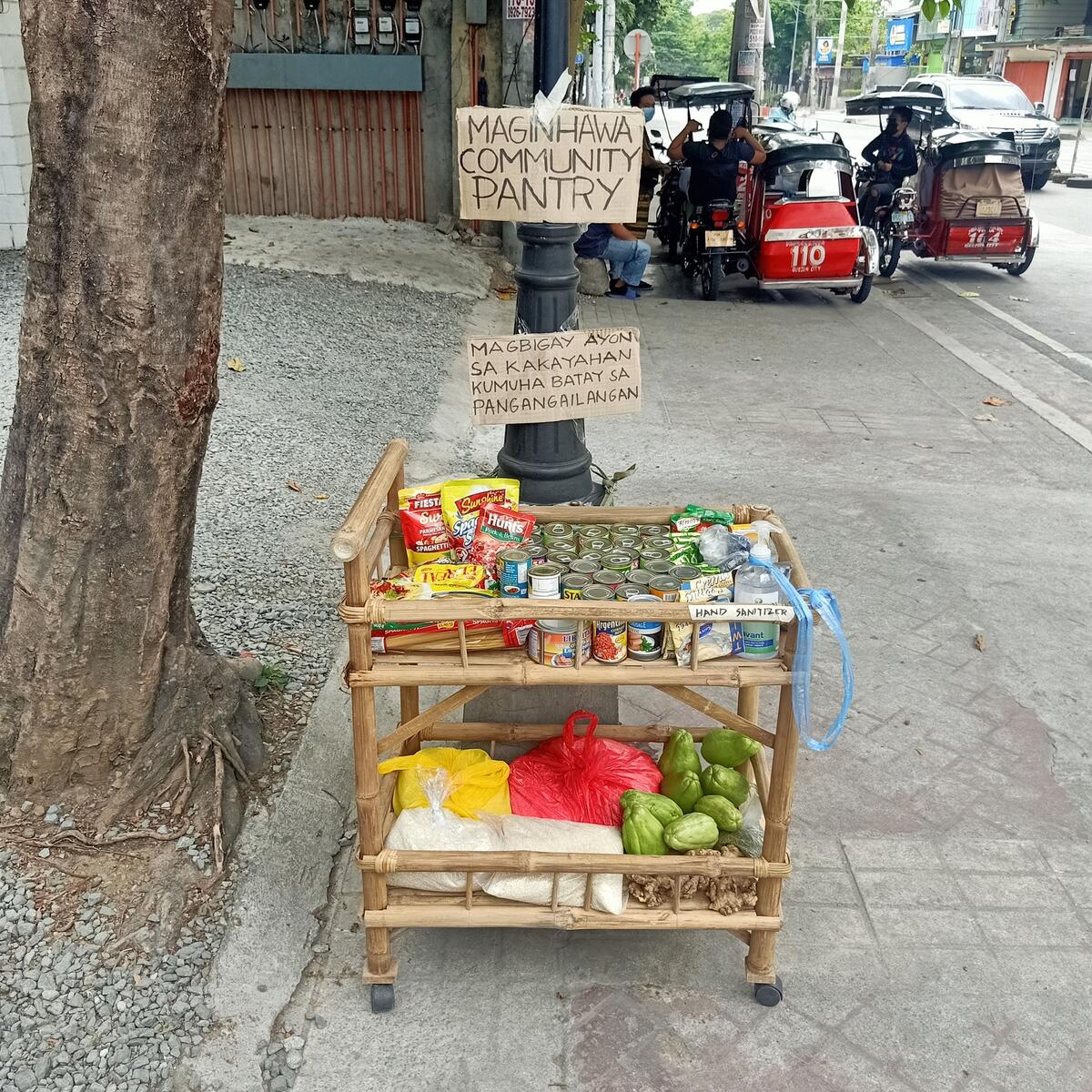
On the 2021 community pantry phenomenon in the Philippines as an example of “social innovation.” Written in December of that year for a graduate course, while trapped in a Christmas COVID quarantine at that. This is by no means my favorite piece of writing, but I was thrilled to be able to incorporate anarchist theory in an academic essay after all this time...
Introduction
The first community pantry in the Philippines manifested along Maginhawa Street, Metro Manila on 14 April 2021, thirteen months into the protracted COVID-19 pandemic lockdown in the nation’s capital region. A local resident left out an unsupervised cart filled with vegetables, rice, and canned goods, together with a sign inviting passersby to “Give according to your ability, take according to your need” [1]. The Maginhawa Community Pantry went viral on social media and within a week, over one hundred similar pantries were created in barangays (towns) and cities throughout the country [2], primarily by independent citizens seeking a space to share food with their communities during the hardships of a seemingly never-ending lockdown [1] [3]. Within five days, the Maginhawa Community Pantry alone received donations from hundreds of concerned individuals and organizations, and served a reported 5,000 beneficiaries [1].
To embed this event in context, the Philippines is ranked by the UN Food and Agriculture Organization as the least food-secure country in Southeast Asia, with 18.8 million Filipinos or 17% of the population suffering severe hunger from lack of access to food in 2019 [4]. The situation was exacerbated by the COVID-19 pandemic, with restricted mobility, loss of jobs and income, and nearly nonexistent government assistance plunging many Filipino families, especially the urban poor, into a dire situation of hunger [5] [6]. Against this background, the community pantry phenomenon made national headlines and was touted by local observers and academics as an innovative grassroots movement by local actors, centered on collective action and mutual care, to meet their own needs amidst the glaring gaps in state measures [5] [7]. This project is thus linked with SDG 2 of the United Nations Sustainable Development Goals to end hunger and achieve food security, especially among the poor, by the year 2030 [8].
Social change is crucial for communities, organizations, and countries to steer action towards sustainable development [9], and yet, the social pillar has remained a neglected aspect of sustainability [10]. One theory related to social sustainability is social innovation [11], which is defined as a reconfiguration of social relations or institutions to address an unmet social need. Throughout the process, it necessarily empowers people to collective action, including transforming existing systems of governance [12].
This paper will analyze community pantries in the Philippines as a case of social innovation. First, I provide a review on mutual aid, with a focus on its part in disaster resilience and its socially innovative potential. Next, I describe community pantries as an example of a mutual aid network arising during the COVID-19 disaster, together with how they have addressed food insecurity and transformed inter-class relations. I conclude with comments on social innovation as a means of short-term relief in addition to promoting long-term sustainability, as well as the crucial role of effective state governance in maximizing the potential of social innovation for sustainable development.
Mutual aid, disasters, and the potential for social change
Mutual aid, or voluntary cooperation and resource exchange to achieve mutual benefit within communities, has helped organize societies long before the emergence of cities, nation-states, and market institutions [13] [14]. It continues to do so today, albeit much eroded by the dominant capitalist ideology of competition for profit [15]. Sociable interactions such as carpooling, taking a stranger’s picture, and maintaining a friendship are some forms of mutual aid that are familiar in Western societies [16]. Among indigenous communities and nations in the Global South, mutual aid often plays a more prominent role in livelihoods (e.g. helping neighbors to harvest and store crops) and serves as a form of social security in the absence of widespread state social protections [17].
Citizen- and community-led responses of mutual aid are gaining recognition as a powerful force for resilience to disasters [18] [19]. Disaster resilience is as much a social process as it is the physical restoration of a pre-disaster environment, requiring the ability of people on the ground to adapt in response to stressors and transition towards improving the conditions that led to a disaster [19].
Another major advantage of bottom-up community-led responses are their promptness and flexibility on the ground, mobilizing to address unmet needs within hours or days after a disaster event [18]. By contrast, it is well known that government or aid sectors can take weeks or months to mount a response due to waiting for bureaucratic approval and funding, or from otherwise weak governance [18]. After Hurricane Katrina devastated New Orleans, the collective efforts of the “Cajun Navy” volunteers rescued more than 10,000 people stranded by floods within two days, well before federal response arrived [20], During the 2019 oil spill off the coast of Brazil, thousands of local volunteers were the first and primary responders in cleaning oil from the beaches while government intervention was reported largely absent [21].
Matthewman and Uekasa [22] describe the occurrence of “utopian moments within disasters,” (p. 973) or moments where the ordinary operations of society are suspended, creating a space where exploitative hierarchical relations are abolished and allow a glimpse into a better world that might be. The social experience of disaster and its disruption of daily life provides “an extraordinary window into social desire and possibility” [23, p. 6]. This is of course not intended to diminish the trauma, bereavement, and loss experienced by many direct victims of disaster, but there can be no denying the role of disasters in shifting awareness among the survivors in the periphery, dispelling the usual loneliness of misfortune, and creating opportunities for substantial positive change [24]. As one example, the 1985 earthquake disaster in Mexico City, which left thousands dead and 250,000 people homeless, saw local grassroots groups organizing to rescue and provide aid to survivors in the political vacuum of a massively corrupt and callous government response [24] [25]. The mobilization of civil society following the 1985 earthquake was considered a key factor in bringing activists into Mexico’s political system, instigating reforms that brought greater power to the local levels [25], and ending the ruling party PRI’s political monopoly in Mexico [24].
It appears that systems of mutual aid that emerge during disasters could present innovative models of social change. They address immediate social needs of disaster resilience and recovery in their respective communities, and nearly always involve empowerment to collective action. The question that remains is whether mutual aid in disaster can involve the third criterion for social innovation, the reconfiguration of social relations. Peter Kropotkin, in his influential dissertation on the topic, argued that mutual aid among humans is a favorable trait that has been promoted by natural selection [14]. Supporting this theory, mutual aid has been an ubiquitous phenomenon in the history of disaster sociology [22]. If mutual aid networks in disaster can be attributed to humans responding “naturally,” to what extent, if any, can an overhaul of eco-social and institutional relations even occur? What are the prospects for such mutual aid networks to create lasting and positive social change? I explore this question in greater detail by analyzing the history, background, and nature of community pantries in the Philippines during the COVID-19 pandemic.
Community pantries: mutual aid and social innovation
The unequivocal disaster that was the COVID-19 crisis in most parts of the world [16] prompted numerous grassroots efforts to quickly and effectively address immediate problems faced by communities, either complementing or filling in gaps left by the state and aid sector’s response [18].
One such grassroots project that emerged and replicated in the Philippines was the “epidemic” of some 4,000 community pantries throughout the islands [26], all inspired by the first food-sharing pantry opened in Maginhawa in April 2021. This was around the time the national government extended a heightened state of lockdown in Metro Manila and surrounding provinces [27], notoriously unaccompanied by food aid or subsidies [5] [6]. The country was still experiencing the worst of the pandemic disaster, with then-record-high cases [28], whole households being infected and hospitals overwhelmed by COVID-19 patients [29]. As pandemic restrictions dragged on, segments of the Filipino middle classes were sliding into the same state of precarity as the urban and rural poor, and a public sentiment of frustration with the lack of official aid had grown widespread [5].
It was from these disillusioned members of the middle-class that the majority of community pantry initiatives seemed to originate [5], as they were the ones with resources to spare. The citizen who set up the Maginhawa Community Pantry, 26-year-old furniture business owner Patricia Non, was able to stockpile food items for the pantry through the help of family and friends, and eventually partnerships with farmers and local vendors [1]. Non stated that she began the project because she was “tired of complaining … [and] tired of inaction” [30, para. 4]. A number of other citizens who initiated community pantries expressed that, while they faced increasing threats of food insecurity in the pandemic, they grew concerned about members of their communities who were struggling more [1]. One couple in Sampaloc, Manila, who started a pantry in their own community inspired by the one in Maginhawa, said they initially doubted that their efforts would be sustained [31]. Shortly afterward, a cohort of Sampaloc community members reached out to provide assistance and help replenish their pantry, leading to their observation that “people were just waiting for a venue where they can help, however much they can” [1, para. 8]. A group of college students who started a community pantry in Bayombong, Nueva Vizcaya also lamented the ongoing pandemic disaster, but explained that they drew inspiration from the community pantry movement: “we also pity the country’s situation… [but] we want to spread this statement of hope through this initiative” [32, para. 45].
Food pantries themselves are not a novel concept, even in response to pandemic-related food insecurity in Southeast Asia. A similar initiative emerged in Thailand in May 2020, known as the Too Pan Sook (“Pantries of Sharing”), which spread as community-led initiatives throughout 43 provinces [33]. The movement itself was inspired by pop-up food pantries in the United States and the Food Bank in Australia, and was also credited with alleviating hunger among vulnerable community members in Thailand [33].
What can be considered the main innovation of Philippine community pantries is the expansion of networks of trust to the community beyond immediate family, friends, and kin, as well as creating inter-class solidarity and dispelling widespread class prejudices regarding the poor [5]. Many Filipino citizen pantry organizers expressed worries that some pantry users would behave selfishly and hoard supplies [31], similar to the hoarding that occurred in supermarkets at the onset of the pandemic [3]. However, there were almost no reports of such behavior occurring at Philippine community pantries, with most beneficiaries taking only what they needed to eat for the day [3] [5]. As a result, inter-class trust networks which did not previously exist were established and maintained around community pantries. The responsible behavior of pantry visitors also served to counter the dominant portrayal of the poor as undisciplined, selfish violators of quarantine restrictions [5] that allegedly contribute to the country’s high COVID-19 caseload, as perpetuated by the administration under President Rodrigo Duterte [34].
A major and seemingly inherent pitfall of community pantries, however, is their unsustainability in the long-term [2] [3]. Four months later in August, many organizers were already reporting difficulties maintaining local pantries with the slowdown of donations, and over 700 pantries had already ceased operations [26]. This is consistent with the observation that mutual aid responses following disaster events tend to decrease over time as individuals exhaust their resources [18]. It is suggested, however, that even temporary projects in the context of disaster management have their merit in building resilience [19]. These time-limited projects are crucial for allowing people to reimagine their environments and their relations with one another, and to transform the negative experience into an opportunity to rebuild better communities [19]. Of course, these grassroots initiatives are more effective when complemented by strong state governance [19], which has unfortunately been consistently lacking in the Philippine setting for many complex reasons (see [35]). Regardless, the community pantries of the Philippines have created a unique space to challenge the national government’s failures and fictions regarding the COVID-19 pandemic disaster [5] [36]. While community pantries per se may not be a long-term sustainable path to food security in the Philippines, they have succeeded in suggesting an innovative possibility for life beyond the current political administration through collective action [5], while in the process also providing much-needed relief for numerous families suffering from present food insecurity [3].
Conclusions
As illustrated in the previous sections, social innovation may occur not just in the form of sustainable long-term strategies to meet unaddressed social needs, but also as temporary or transitional ways to meet such needs. Stability in the short-term is important to create conditions under which sustainability can be considered, although a lack of potential for sustainability should be considered a pitfall.
An initiative such as the ones exemplified by Philippine community pantries are an example of social innovation that works in a socially transformative, although short-term and likely unsustainable manner. These projects involve bottom-up, collective efforts by communities to help ensure one another’s immediate food security, in the process creating emergent inter-class networks of trust and mutual care. Transitional projects such as these are nevertheless a vital aspect of the process of learning from disasters and building resilience. Significant overhauls in state governance, such as the eradication of corruption and bureaucratic inefficiencies, will be required to realize the full potential of these socially innovative practices towards sustainable development, especially in the context of the Philippines and similar developing countries
References
[1] Suazo, J. (2021, April 19). What the Community Pantry Movement means for Filipinos. CNN Philippines. https://cnnphilippines.com/life/culture/2021/4/19/community-pantry-filipinospandemic.html
[2] Dancel, R. (2021, April 20). Community pantries sprout across the Philippines amid flailing govt response to Covid-19 pandemic. The Straits Times. https://www.straitstimes.com/asia/se-asia/fuelled-by-flailing-govt-response-to-pandemic-community-pantries-sprout-across-the
[3] Wong, A.C. (2021, May 6). Philippines community pantries give help – and send a message. The Interpreter. https://www.lowyinstitute.org/the-interpreter/philippines-community-pantries- give-help-send-message
[4] FAO, IFAD, UNICEF, WFP and WHO. (2020). The State of Food Security and Nutrition in the World 2020. Transforming food systems for affordable healthy diets. https://www.fao.org/3/ca9692en/online/ca9692en.html
[5] Dionisio, J., Alamon, A., Yee, D., Palanca, K.A.J., Sanchez, F., Mizushima, S.M., & Alvarez, J.J. (2021, April 19). Contagion of mutual aid in the Philippines. Philippine Sociological Society. http://philippinesociology.com/contagion-of-mutual-aid-in-the-philippines/
[6] Howell, M. (2021, November 18). Bayanihan: community pantries in the Philippines. Borgen Magazine. https://www.borgenmagazine.com/bayanihan-community-pantries-in-the-philippines/
[7] Valenzuela, N. (2021). Community pantry: ‘Not charity, but mutual aid.’ Inquirer.Net. https://newsinfo.inquirer.net/1420463/community-pantry-not-charity-but-mutual-aid
[8] UN Development Programme. (2021). The SDGs in action. https://www.undp.org/sustainable -development-goals
[9] Filho, W.L., Fritzen, B., Ruiz Vargas, V., Paço, A., Zhang, Q., Doni, F., Azul, A. M., Vasconcelos, C. R. P., Nikolaou, I. E., Skouloudis, A., Weresa, M. A., Marczewska, M., Price, E., Anholon, R., Rampasso, I., Quelhas, O., Lange Salvia, A., Ozuyar, P. G., Moggi, S., & Wu, Y. J. (2021). Social innovation for sustainable development: Assessing current trends. International Journal of Sustainable Development & World Ecology, 1–12. https://doi.org/10.1080/13504509.2021.2013974
[10] Parra, C. & Moulaert, F. (2010). Why sustainability is so fragilely ‘social.’ In S. Oosterlynck, J. Van den Broeck, L. Albrechts, F. Moulaert, and A. Verhetsel (Eds.), Strategic Spatial Projects: Catalysts for Change (pp. 242-256). Routledge.
[11] Parra, C. (2013). Social sustainability: a competing concept to social innovation? In F. Moulaert, D. MacCallum, A. Mehmood, and A. Hamdouch (Eds.), The International Handbook on Social Innovation: Collective Action, Social Learning, and Transdisciplinary Research (pp. 142-154). Elgar.
[12] Moulaert, F. & MacCallum, D. (2019). Introduction to social innovation. In F. Moulaert & D. McCallum (Eds.), Advanced Introduction to Social Innovation. (pp. 1-9). Elgar.
[13] O’Hearn, D., & Grubačić, A. (2016). Capitalism, mutual aid, and material life: Understanding exilic spaces. Capital & Class, 40(1), 147–165. https://doi.org/10.1177/0309816816628562
[14] Kropotkin, P (2012). Mutual Aid: A Factor of Evolution. London: Forgotten Books. (Original work published in 1902)
[15] Wigger, A., & Buch-Hansen, H. (2013). Competition, the Global Crisis, and Alternatives to Neoliberal Capitalism: A Critical Engagement with Anarchism. New Political Science, 35(4), 604–626. https://doi.org/10.1080/07393148.2013.848705
[16] Springer, S. (2020). Caring geographies: The COVID-19 interregnum and a return to mutual aid. Dialogues in Human Geography, 10(2), 112–115. https://doi.org/10.1177/2043820620931277
[17] Midgley & Hosaka (2011). (Eds.) Grassroots Social Security in Asia. Routledge.
[18] Carstensen, N., Mudhar, M., & Munksgaard, F. S. (2021). ‘Let communities do their work’: The role of mutual aid and self‐help groups in the Covid‐19 pandemic response. Disasters, disa.12515. https://doi.org/10.1111/disa.12515
[19] Bakema, M. M., Parra, C., & McCann, P. (2019). Learning from the rubble: The case of Christchurch, New Zealand, after the 2010 and 2011 earthquakes. Disasters, 43(2), 431–455. https://doi.org/10.1111/disa.12322
[20] CBS News. (2015, August 29.) How citizens turned into saviors after Katrina struck. https://www.cbsnews.com/news/remembering-the-cajun-navy-10-years-after-hurricane-katrina/
[21] Phillips, D. (2019, November 7). Oil spill threatens vast areas of mangroves and coral reefs in Brazil. The Guardian. https://www.theguardian.com/environment/2019/nov/07/oil-spill-threatens-vast-areas-of-mangroves-and-coral-reefs-in-brazil
[22] Matthewman, S., & Uekusa, S. (2021). Theorizing disaster communitas. Theory and Society, 50(6), 965–984. https://doi.org/10.1007/s11186-021-09442-4
[23] Solnit, R. (2009) A Paradise Built in Hell: The Extraordinary Communities That Arise in Disaster. New York: Viking Press.
[24] Solnit, R. (2005). The uses of disaster: Notes on bad weather and good government. Harper’s Magazine, October 2005 (pp. 31–37).
[25] Adler, D. (2015, Sept 18). The Mexico City earthquake, 30 years on: have the lessons been forgotten? The Guardian. https://www.theguardian.com/cities/2015/sep/18/mexico-city- earthquake-30-years-lessons
[26] De Leon, D. (2021, August 3). ECQ reignites calls for donations to community pantries. Rappler. https://www.rappler.com/nation/ecq-reignites-calls-donations-community-pantries-august-2021/.
[27] Channel News Asia. (2021, April 3). Philippines extends coronavirus curbs in capital, nearby provinces. https://www.channelnewsasia.com/asia/philippines-covid-19-curbs-lockdown-manila- extended-192991
[28] Rappler (2021, August 30). Philippines reports record-high 22,366 COVID-19 cases. https://www.rappler.com/nation/coronavirus-cases-philippines-august-30-2021/
[29] Tomacruz, S. & Magsambol, B. (2021, April 17). Philippines’ COVID-19 surge tears through families. Rappler. https://www.rappler.com/newsbreak/in-depth/philippines-covid-19-surge-tears-through-families- lives/
[30] Gozum, I. (2021, April 17). ‘Pagod na ako sa inaction’: How a community pantry rose to fill gaps in gov’t response. Rappler. https://www.rappler.com/moveph/community-pantry- covid-19-lockdown-april-2021/
[31] Lalu, G.P. (2021, April 16). ‘Giving and taking in time of crisis:’ Community pantries sprout in NCR. Inquirer.net. https://newsinfo.inquirer.net/1420110/giving-and-taking-in-time-of-crisis- community-pantries-sprout-in-ncr
[32] Bagaoisan, A. (2021, April 16). LOOK: Maginhawa ‘pan-tree’ inspires other community efforts. ABS-CBN News. https://news.abs-cbn.com/life/04/16/21/look-maginhawa-pan-tree-inspires- other-community-pantries-in-qc-manila
[33] Chang, S. (2020, November 20). Thailand’s Community Pantries: Cooking up a future for the Thai Civil Society? Shape SEA. https://shapesea.com/op-ed/covid-19/thailands-community- pantries-cooking-up-a-future-for-the-thai-civil-society/
[34] Hapal, K. (2021). The Philippines’ COVID-19 Response: Securitising the Pandemic and Disciplining the Pasaway. Journal of Current Southeast Asian Affairs, 40(2), 224–244. https://doi.org/10.1177/1868103421994261
[35] Brillo, B. B. C. (2011). A Theoretical Review on Philippine Policy-making: The Weak State-Elitist Framework and the Pluralist Perspective. Philippine Quarterly of Culture and Society, 39(1), 54–76.
[36] Rivera, K. (2021, April 19). On community pantries. Inquirer.net. https://opinion.inquirer.net/139447/on-community-pantries

Leave a Reply